Luxury Hotel Bathroom Success: A Designer's Perspective on Premium Fixture Selection
Tuesday 06 October 2026
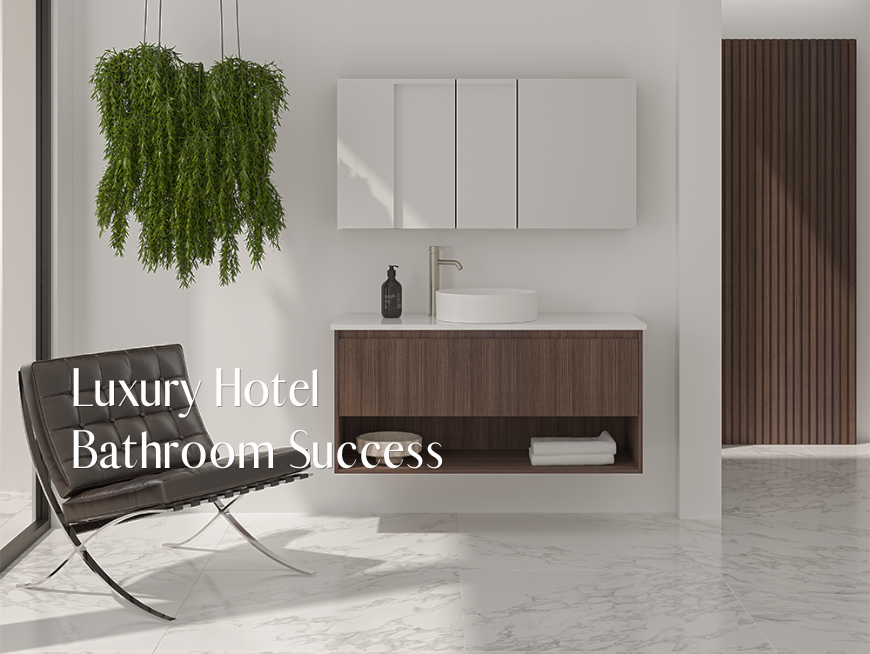
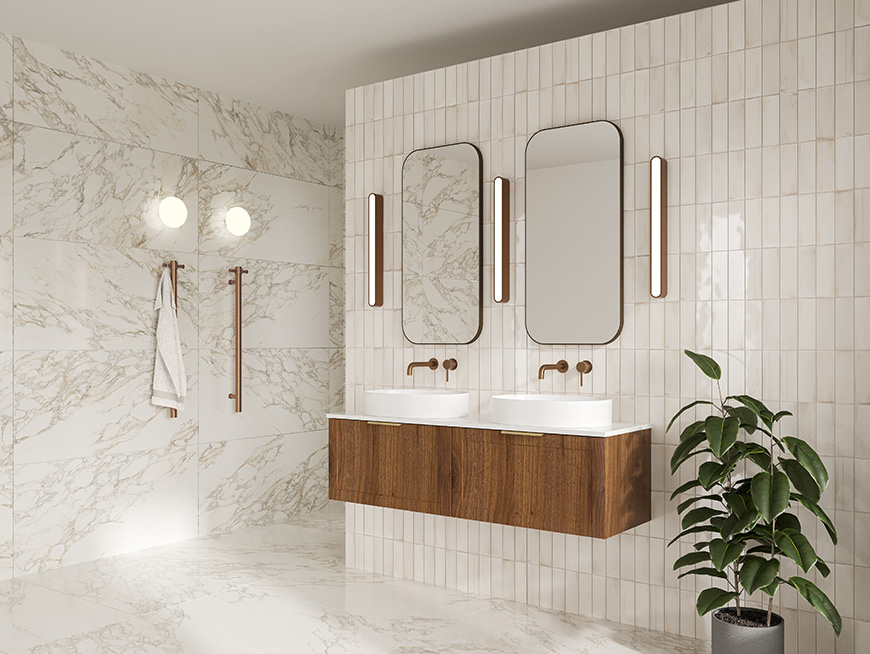
A luxury hotel bathroom succeeds when premium bathroom fixtures selection is treated as a design decision and an operational decision at the same time. The tapware, basins, baths, showers, vanities, toilets and accessories a guest sees and touches need to share one design language, hold their finish under daily commercial cleaning, and be repeatable across every room and every property. Get those three things right at the specification stage, and the luxury bathroom design guests see on opening day is the one they still see years later.
There is a point in every hotel stay when the guest gets closer to the design than at any other time. It’s not in the lobby, and it’s not in the restaurant. It’s at the basin, with a hand on the mixer, a few centimetres from the finish, with nothing else competing for attention. Whatever the brand has promised in its photography is either confirmed or quietly contradicted in that moment.
Designers who work in luxury hospitality know this well. Lauren Rottet, founding principal of Rottet Studio, put it simply in HOTELS Magazine's feature on hotel bathroom design: "A good bathroom experience translates to a good hotel experience." The guest data points the same way. J.D. Power's 2025 North America Hotel Guest Satisfaction Index Study reported that satisfaction improved year on year in the areas where owners had invested, and it named the condition of bathroom fixtures alongside guest room furnishings and bed comfort.
Our earlier posts for hospitality teams covered the engineering side of the brief: why hospitality projects choose premium fixtures for durability, how tapware compliance and guest experience meet, and what belongs in a hotel bathroom specification document. This post takes the designer's seat. It is written for interior designers and specifiers who already have a project on the desk, a suite of rooms to resolve, and a decision to make about which fixtures will carry a luxurious feel from the entry-level room to the penthouse.
Robertson Bathware has supplied premium bathroom products to New Zealand projects since 1987, and our architectural and design consultants work on hotel specifications from early concept through to post-installation support. What follows is how we see the decision from that position.
Premium vs standard: where the difference actually sits
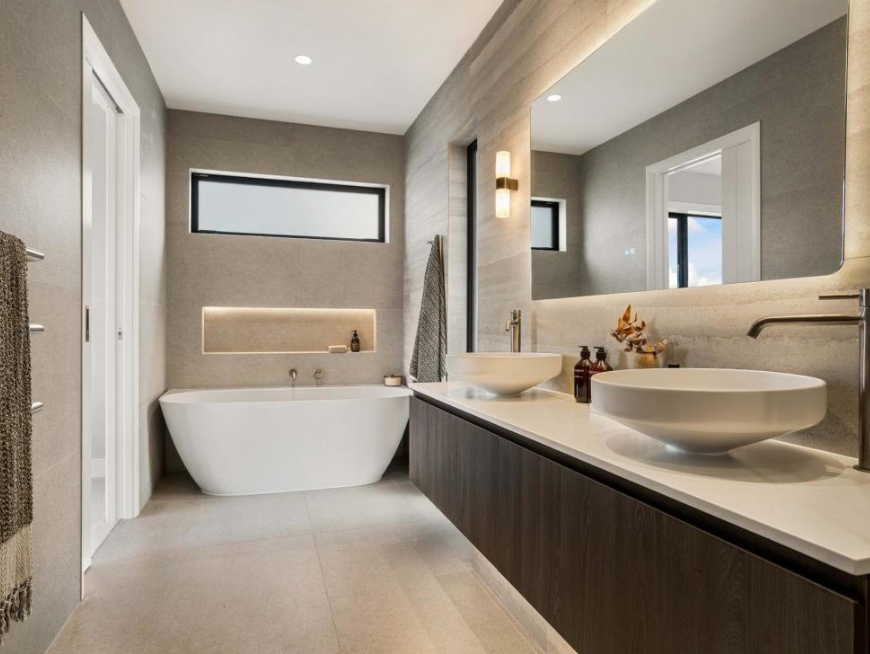
On a showroom wall, a standard basin mixer and a premium one can look closer than their prices suggest. The difference shows up in three places a specifier cares about: what the product is made from, how wide and coordinated the range is, and what stands behind it once the hotel is open.
| What to compare | Standard product (typically) | Premium product (typically) |
| Materials | Lighter bodies, basic ceramics, acrylic baths | Heavier brass bodies, fine ceramics, stone composite baths and basins |
| Finish | One or two finishes, limited match between categories | A finish family carried across tapware, showers and accessories |
| Range depth | A handful of configurations | Wall-mounted, deck-mounted, freestanding and thermostatic options within one collection |
| Serviceability | Parts supply uncertain once a model is superseded | Serviceable cartridges and a documented spares path |
| Documentation | Basic compliance information | WELS ratings, declarations of compliance, technical drawings and warranty terms ready at specification stage |
| Design authorship | Generic forms | Collections developed by named designers, with a recognisable design language |
Individual products vary, so treat the table as a set of questions to put to any supplier and not as a rule.
Materials are where the guest notices the difference first. A freestanding bath from Victoria + Albert is cast in the manufacturer's own Quarrycast, a blend of volcanic limestone and resin that the company developed more than 30 years ago. It has a mass and a warmth to the touch that a thin acrylic shell does not, and guests register that without knowing why.
Compliance is the other dividing line, and since this year it’s not optional. From 2 May 2026, G12/AS1 Amendment 14 requires any copper alloy product in contact with drinking water to contain no more than 0.25% lead, with pressurised components made from dezincification-resistant (DZR) brass. Every tapware product in Robertson's current range meets that requirement, and our specifier's guide to the amendment covers the documentation in detail.
"When a designer asks me what they are paying for with a premium range, I point to the things that will still matter in year ten," says James Robertson, General Manager (Distribution) at Robertson Bathware. "The finish that still matches from room to room, the part we can still supply, and the paperwork that was right the first time. The look is what wins the client presentation. Those three things are what protect it."
You can read more about James and the Robertson team at robertson.co.nz/our-people.
Aesthetic impact on the guest experience
Luxury bathroom design in a hotel is judged at arm's length and in seconds. A guest will not count the tap holes or read the brand on the waste, but they will feel whether the lever moves with weight, whether the shower holds its temperature, and whether the towel rail belongs to the same family as the mixer.
The direction of hospitality design makes this more important, not less. Hospitality Design's review of the movements that defined 2025 describes an industry moving away from visual excess and towards material honesty, craft and how a space makes a guest feel. In a bathroom, the materials and the craft are the fixtures. There is very little else in the room.
It helps to think about each product category by the job it does in the guest's impression:
- Tapware. The first thing a guest touches. The weight and action of the handle and the quality of the finish set the tone for everything else. Explore Robertson's tapware and mixers, including Zucchetti and Elementi.
- Baths. The focal point of a suite, and often the image the hotel uses to sell it. A freestanding bath positioned for a view does more for perceived luxury than almost any other single item.
- Showers. The fixture every guest uses, every stay. Generous overhead heads and thermostatic mixers deliver a consistent experience regardless of what the rest of the building is drawing. See the full shower range.
- Basins and vanities. The surface the guest lives at. Basin form and vanity proportion decide whether the room feels generous or merely furnished.
- Toilets. The quiet indicator of quality. Wall-hung, rimless pans with concealed cisterns keep the floor clear and the lines clean.
- Accessories. The finishing layer, and the one most often let down by late decisions. Our post on bathroom accessory coordination covers how to keep accessories and heated towel rails in step with the tapware.
- What is the body made of? Tapware in DZR brass resists dezincification, the corrosion that affects standard brass alloys over time. It is also now a Building Code requirement for pressurised components in contact with drinking water.
- How is the finish applied? Coloured finishes produced by PVD (physical vapour deposition) are generally regarded as harder wearing than painted or lacquered equivalents. Ask the supplier which process is used on the exact product and finish you are specifying, because it can differ within a single range.
- Are the surfaces non-porous? Basins, baths and vanity tops need to shrug off cosmetics, hair dye and commercial cleaning products without staining.
- Can it be serviced in place? A cartridge that can be changed without removing the fitting keeps a room in service. A fitting that has to come off the wall does not.
- Will parts still be available? A facilities team maintaining 150 rooms needs a small, standard spares inventory and a supplier who can replenish it.
- A core palette with room to localise. Fix the elements a returning guest recognises, such as the tapware collection and the primary finish. Leave the bath, the basin form or the vanity material free to respond to the site.
- Collections, not individual picks. Specifying within a coordinated family across tapware, showers and accessories means every later property draws from the same design language.
- Finish codes, not finish names. "Brushed brass" varies noticeably between manufacturers. A manufacturer's finish code does not.
- Retained control samples. Keep a signed-off physical sample of every finish. It is the only reliable reference when property three is being matched to property one.
- A supply view that runs past opening day. Ask how long a collection is expected to stay in production and how spares will be supported. Extensions and refurbishments need to match what is already installed.
- Tapware and mixers
- Baths
- Showers
- Basins
- Vanities and furniture
- Toilets
- Accessories
"The bathrooms that guests remember are rarely the ones with the most in them," says Aaron McMillan, Architectural & Design Consultant at Robertson Bathware. "They are the ones where nothing jars. The mixer, the basin, the bath filler and the robe hook all look as though one person chose them on one day. That calm is what reads as luxury, and it is very hard to achieve if each category is picked in isolation."
Durability under heavy use
A hotel bathroom has a harder life than any residential one. It is used by a different person every few nights, none of whom has any reason to treat it gently, and it is cleaned every day by a housekeeping team working to a time allowance per room. A fixture that looks beautiful on the sample board has to look the same after several years of that.
For a designer, the durability questions worth asking at selection stage are these:
That last point is where local support earns its place. Robertson Trade, our parts and service division, holds replacement components for the brands we specify, so a failed cartridge is a prompt repair and not a room out of inventory. Our earlier post on commercial bathroom durability goes further into how commercial and residential products differ.
Maintenance requirements for luxury finishes
In our experience, many of the finish problems that appear in hotels are not product failures. They are cleaning failures. A brushed brass mixer or a matte black shower column will hold its appearance for years under the right regime, and can be dulled far sooner by an acidic descaler or an abrasive pad used with the best of intentions.
This makes the maintenance regime part of the design. If the finish schedule and the housekeeping chemical list are written by two teams who never speak, the finish schedule loses.
The guidance below is drawn from Robertson's own Product Care Guide, which is worth attaching to the handover documentation for any project.
| Surface | Routine care | Avoid |
| Tapware and accessories, all finishes | Warm soapy water and a soft cloth, little and often | Steel wool or pads, abrasive polishes, harsh cleaners, anything acidic (including citrus), steam cleaners |
| Apaiser marble composite baths and basins | Water and a microfibre cloth daily, rinsed and dried. A cream-based cleanser for a deeper clean | Products containing sulfamic acid, which will damage the surface and void the manufacturer's warranty |
| Natural stone and marble | A soft damp cloth with a pH-neutral stone cleaner or mild soap. Reseal every three to six months | Abrasives, vinegar, window cleaner, bleach, ammonia |
| EleStone vanity tops | Soap and water with a sponge. Diluted cream cleanser for stubborn marks | Heat from hair straighteners, strong solvents such as acetone |
Three practical points follow from this for a hotel specification:
- Match the finish to the operator's regime. Chrome is the most forgiving finish. Matte black shows water marks more readily and needs wiping dry to stay crisp. Neither is wrong, but the operator should know which they are getting.
- Write the care requirements into the handover. Housekeeping contractors change. The finish care instructions should sit with the facilities team, not in a designer's project folder.
- Treat natural stone as a commitment. A resealing cycle every three to six months is a real operating cost across 180 rooms. A stone composite may give the same visual warmth with less upkeep.
"We would always prefer a designer asks us the awkward maintenance question before the finish is locked in," says Nicola Earle, Architectural Consultant - South Island at Robertson Bathware. "A special finish in a hotel can look superb for a very long time, but only if the people cleaning it have been told what it is and how to look after it. That conversation takes ten minutes at specification stage and saves a great deal of disappointment later."
Design continuity across properties
Consistency within one hotel is a matter of discipline. Consistency across a portfolio, where properties open years apart and are built by different contractors, is a matter of system design.
Alexander Zilberman, founder of Alexander Zilberman Architecture, named the tension in the same HOTELS Magazine feature: "It's hard to design something that feels bespoke and unique while also being repeatable in construction." Fixture selection is where that tension is either resolved or left for someone else to deal with on site.
The approaches we see working for multi-property groups have a few things in common:
Our hotel bathroom specification guide explains how to document this, including the approved-alternatives matrix that protects a design when a product becomes unavailable part-way through a programme.
Budget management for premium projects
No hotel project has an unlimited fixtures budget, and a designer who specifies as though it does will see the scheme value-engineered by someone with less interest in how it looks. The better approach is to decide where the money works hardest before anyone else decides for you.
Spend where the guest's hand goes. Basin mixers, shower controls and the bath filler are touched on every stay. Concealed components need to be reliable and compliant, but they do not need to carry the design.
Tier by room type, within one family. A collection with several price points lets the standard room, the suite and the spa share a design language while the specification steps up. The premium is then spent where the room rate supports it.
Count the cost of ownership, not the cost of purchase. Hotels reinvest continuously to stay presentable. The CapEx 2023 study from the International Society of Hospitality Consultants and the Hospitality Asset Management Association put capital spending for US hotels at approximately 9% of revenue. That is US data and New Zealand figures will differ, but the principle travels: a fixture that has to be replaced early is drawing on a budget the owner would rather spend elsewhere.
Consolidate the supply. One supplier across tapware, sanitaryware, baths and accessories means one set of documentation, one delivery programme and one conversation when something changes.
Lock pricing and staging early. Agreeing project pricing and a staged delivery schedule at the outset protects the budget across a long build.
"The schemes that survive value engineering are the ones where the designer has already made the trade-offs," says James Robertson. "If we know early which three or four items carry the room, we can help protect those and find sensible savings elsewhere in the same family. Once a quantity surveyor is cutting line by line, with no view of the design intent, it is usually the visible items that go first."
Sourcing exclusive finishes
A finish that a guest has not seen in another hotel is one of the most direct ways to give a property its own identity. It is also the part of a specification with the least tolerance for late decisions.
The Cordis Pinnacle Tower in Auckland shows what is possible. Working with interior designers Space Studio, Robertson supplied custom brushed gold PVD tapware throughout, with Zucchetti mixers and showers alongside the Victoria + Albert Taizu freestanding bath. The finish was made for the project, and it reads that way.
If an exclusive or custom finish is part of your concept, plan for the following:
- Start the conversation at concept stage. Custom finishes are made to order and carry longer lead times than stocked finishes. The exact lead time depends on the brand and the finish, so ask for it in writing before the programme is fixed.
- Approve physical samples in project lighting. A warm metallic finish can shift noticeably between showroom lighting and the colour temperature specified for the guest room.
- Confirm the finish exists across every category. A custom tapware finish needs matching shower components, wastes, accessories and flush plates, or a deliberate plan for where the finish stops.
- Order attic stock with the main run. Spare units and components ordered in the same production run are the surest way to match a replacement some years after opening.
- Agree the fallback. Decide in advance which standard finish is the approved alternative if the custom run is delayed.
"A custom finish is completely achievable on a hotel project, and it is often what makes the bathroom feel like it belongs to that property and no other," says Kirsten Robertson, Architectural Consultant & HR Assistant (Auckland) at Robertson Bathware. "What it needs is time. When a designer brings us in while the concept boards are still moving, we can go back to our European suppliers, get samples made and have them on the table well before anything has to be ordered."
Robertson's long-standing relationships with European design houses including Zucchetti, Victoria + Albert, Samuel Heath and Flaminia, and with Apaiser for stone composite baths and basins, are what make this practical for a New Zealand project. Our architects and designers team can advise which collections are available in special finishes for a given programme.
Design storytelling through fixtures
In luxury design, the strongest hotel interiors are built around a narrative, and the bathroom is where that narrative is tested. As Alexander Zilberman puts it, "The bathroom is part of the story the hotel operator is telling." Hospitality Design's 2025 review makes the wider point: the projects that stood out were those that moved beyond a uniform global look and built their design around local culture, history and place.
Fixtures carry a story in three ways.
Material. Stone composite, fine ceramic, brushed metal and timber each say something different. A cast stone basin speaks of permanence and landscape. A fine-edged ceramic one speaks of precision.
Finish. Warm metallics suggest craft and heritage. Chrome and steel suggest clarity and modernity. Matte black gives graphic contrast. The finish is often the single clearest signal of what kind of hotel this is.
Form. Soft, organic profiles and crisp, geometric ones belong to different stories. Mixing them without intent is the quickest way to lose the thread.
Te Arikinui Pullman Auckland Airport is a New Zealand example worth studying. The interior concept, "Sea to Sky", draws on land, sea and sky and acknowledges the heritage of the Tainui people, moving from earthy tones on the lower floors to lighter, airier ones above. Robertson worked with Warren and Mahoney and Space Studio on the bathrooms for the hotel's 311 rooms, which use Elementi Ion tapware, the Marzo freestanding bath, Parisi Tondo column basins and the Linfa rimless wall-hung pan. A consistent set of fixtures runs through the whole building, quiet enough to let the changing palette tell the story from floor to floor.
That is the role fixtures play in designer bathroom inspiration at hotel scale. They are rarely the loudest element in the room. They are the constant that makes the rest of the narrative believable.
"When a designer walks us through the concept before we talk about products, the selection gets better," says Aaron McMillan. "If the story is about the coast, or about a heritage building, or about a particular material, we can point to the collection and the finish that carry it. Starting from a product list and trying to attach a story afterwards never works as well."
-1791244513-COPY.png)
Where to start
Premium fixture selection for a hotel comes down to a sequence. Settle the story, choose the collection and finish that carry it, test both against the operator's cleaning regime and the owner's budget, and bring the supplier in while there is still time to sample, customise and plan delivery.
Robertson's architectural and design consultants are available for early-stage concept reviews, product presentations, finish sampling and compliance documentation for hotel projects anywhere in New Zealand. You can see products together, in their actual finishes, at our Auckland and Christchurch showrooms.
Explore the range for your next hospitality project:
Talk to a Robertson architectural consultant about your hotel project
Robertson Bathware has been supplying premium bathroom products to New Zealand homes, hotels and commercial projects since 1987. Our architectural and design team works with interior designers, specifiers and developers from early concept through to post-installation support.
FAQs: luxury hotel bathroom design and fixture selection
What makes a hotel bathroom feel luxurious to guests?
Coherence and tactile quality, more than any single feature. Guests respond to fixtures that share one design language, a finish that matches from the mixer to the robe hook, materials with real weight, and a shower that performs consistently. A freestanding bath or a distinctive finish adds a focal point, but it only works when the rest of the room is resolved around it.
Are premium bathroom fixtures worth the higher cost for a hotel project?
In most cases, yes, provided the comparison is made on cost of ownership and not purchase price. Premium fixtures generally offer better finish consistency across large orders, serviceable components, a reliable supply of spare parts and complete compliance documentation. Those reduce rooms out of service and early replacement, which are the costs that matter to an operator.
Which tapware finishes are easiest to maintain in a hotel?
Chrome is the most forgiving finish and the simplest for housekeeping teams. Brushed finishes tend to disguise fingerprints and light water marks. Matte black shows water marks more readily and benefits from being wiped dry. Whatever the finish, Robertson's care guidance is the same: warm soapy water and a soft cloth, with no abrasive pads, acidic cleaners or steam cleaners.
How do you keep bathroom design consistent across several hotel properties?
Specify from coordinated collections, record finishes by manufacturer code, keep signed-off control samples, and agree an approved alternative for every product. It also helps to fix the elements guests recognise, such as the tapware collection and primary finish, while leaving other elements free to respond to each site.
Can custom or exclusive finishes be supplied for a New Zealand hotel project?
Yes. Robertson supplied custom brushed gold PVD tapware for the Cordis Pinnacle Tower in Auckland, for example. Custom finishes are made to order, so they need to be raised at concept stage, sampled under the project's own lighting, and ordered with spare stock from the same production run.