WELS & NZ Building Code: Everything You Need to Know About Bathroom Compliance
Friday 21 August 2026
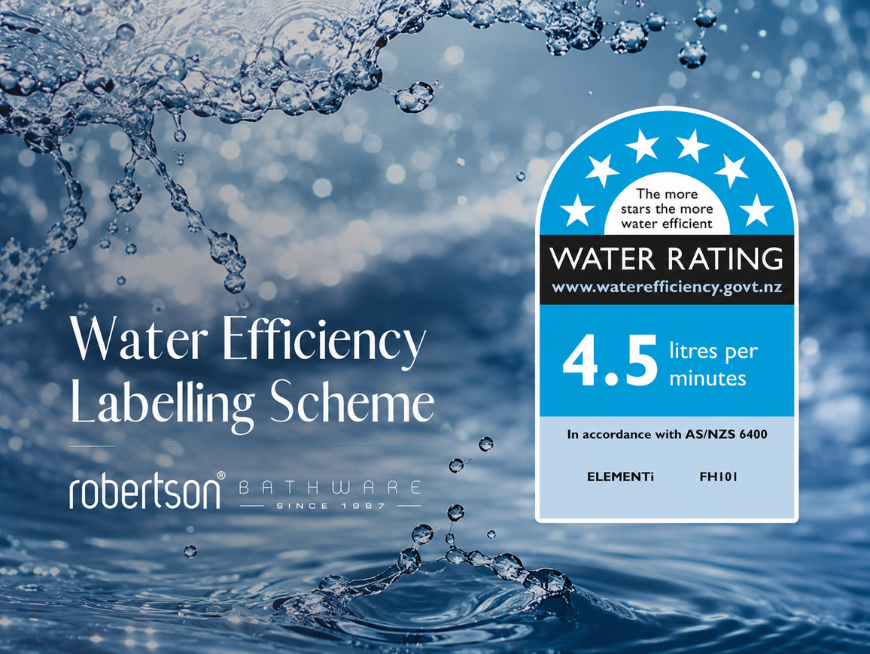
If you have shopped for a tap, shower or toilet in New Zealand any time in the last decade, you have almost certainly seen a small blue-and-white label with a star rating on it. That label is part of the Water Efficiency Labelling Scheme - WELS -, and it is just one part of a broader compliance picture that governs every water-using product in a New Zealand bathroom or kitchen.
This guide brings the full picture together: what WELS actually measures, how it sits alongside New Zealand Building Code requirements, what "compliant" really means for the products in your bathroom, and how to verify it, whether you are a plumber on-site, an architect specifying for a hotel, or a homeowner planning a renovation.
We have covered the lead-free and DZR brass side of compliance in detail in earlier posts - see our original announcement, what DZR brass means, and our specifier's guide. This post takes a step back to cover the water efficiency side of the picture, with DZR compliance referenced briefly where it overlaps.
What is WELS, and why doe
-1787275446-COPY.png)
s it exist?
The Water Efficiency Labelling Scheme was introduced in New Zealand in 2010 and has been mandatory since 1 April 2011 under the Consumer Information Standards (Water Efficiency) Regulations, made under the Fair Trading Act. It is administered by the Commerce Commission and applies to taps, showers, toilets, urinals, clothes washers and dishwashers sold in New Zealand.
The purpose of WELS is straightforward: to give consumers, tradies and specifiers a simple, standardised way to compare the water efficiency of similar products at the point of sale, without needing to interpret technical flow-rate data themselves.
Every covered product must display a WELS label, either on the product or at the point of sale, showing two key pieces of information: a star rating from zero to six, and the underlying water consumption or flow rate figure the rating is based on. The rating is determined under the joint Australian/New Zealand testing standard, AS/NZS 6400, which ensures the rating is comparable across brands and product types.
The WELS star rating system explained (0–6 stars)
The star rating is the part most people recognise, and it works exactly as you would expect: more stars means better water efficiency, with the same overall performance expected regardless of rating.
0–1 stars: Products at this end of the scale use significantly more water than is now considered efficient. You will rarely find new products at this rating on the market today, as manufacturers have moved toward higher-efficiency designs.
2–3 stars: A middle range that still meets New Zealand Building Code minimum flow requirements but offers more modest water savings compared to top-rated alternatives.
4 stars: A strong, widely available standard for many tapware and shower products - a sensible everyday benchmark for most residential applications.
5–6 stars: The most water-efficient products on the market, using advanced aerator and flow-restriction technology to maintain a comfortable, functional water experience while using significantly less water than older or lower-rated products.
It's worth being clear about one thing: a higher star rating does not mean weaker water pressure or a worse user experience. Modern high-efficiency tapware and shower technology - aerating mixers, pressure-compensating shower heads - is specifically engineered to maintain the feel of strong flow while using meaningfully less water. The days of "efficient" meaning "underwhelming" are largely behind us.
James Robertson, General Manager Distribution at Robertson Bathware, has watched this shift in expectations play out across the industry. "A few years ago, there was a perception that water-efficient meant compromised performance," he says. "That's no longer the case. The engineering in modern aerators and flow controllers means a 5 or 6-star product can deliver a genuinely premium showering or washing experience while using a fraction of the water older fittings did. We see this as a real point of difference for specifiers and homeowners who care about sustainability without wanting to sacrifice the experience."
You can read more about James and the Robertson team on our About Us page.
-1787275460-COPY.png)
How WELS sits alongside the NZ Building Code
WELS and the Building Code are related but distinct systems, and understanding the difference matters if you are specifying or installing bathroom products.
WELS is a consumer information standard. It requires water-using products to be labelled with their efficiency rating so buyers can compare them. It does not, by itself, set a mandatory minimum efficiency level for every product - a 1-star product can still legally be sold, provided it is correctly labelled.
The Building Code, by contrast, sets mandatory minimum performance requirements. Clause G12 (Water Supplies) and its Acceptable Solution, G12/AS1, specify minimum and maximum flow rates that sanitary fixtures must deliver to function correctly and safely, covering basins, baths, showers, sinks and laundry tubs. These requirements exist primarily for functional performance and safety (for example, ensuring adequate flow for normal use, and managing hot water temperature to avoid scalding risk) rather than for efficiency specifically.
In practice, the two systems work together. The Building Code sets the performance floor a product must meet to be installed at all. WELS then tells you, within that compliant range, how water-efficient a given product is compared to its alternatives, letting you make a more sustainable choice without compromising on Building Code performance.
There is also a third layer relevant to tapware and fittings specifically: the lead-free and DZR brass requirements introduced under G12/AS1 Amendment 14, which came into effect on 2 May 2026. These requirements govern the material composition of copper alloy components in contact with potable water - a separate compliance question from water efficiency, but one that applies to many of the same products (basin mixers, kitchen mixers, valves) covered by WELS. For a full explanation of this requirement, see our dedicated posts linked above.
"It's a fair question we get from specifiers — how do WELS, the Building Code flow requirements, and the new lead and DZR rules all fit together?" says James Robertson. "The simplest way to think about it is that the Building Code and the lead/DZR rules are both about whether a product is allowed to be installed at all, performance and material safety. WELS sits on top of that, helping you choose the most efficient option among products that already meet those baseline requirements."
Water efficiency standards by product type
Different bathroom and kitchen products are assessed against different flow rate benchmarks under WELS, reflecting their different functions.
Tapware (basin mixers, kitchen mixers): Rated primarily on flow rate in litres per minute. A 6-star basin mixer typically delivers around 4–6 litres per minute, compared to 9 litres per minute or more for an unrated or low-rated product.
Showers: Rated on flow rate, with top-rated shower products typically delivering in the range of 6–9 litres per minute while still providing strong, satisfying coverage through aerated or pressure-optimised spray technology.
Toilets: Rated on average flush volume across full and half flush cycles, with dual-flush systems generally achieving higher star ratings than older single-flush designs.
Urinals: Rated on flush volume per use, with sensor-operated and low-flush designs achieving the highest ratings - frequently specified in commercial settings for both efficiency and hygiene benefits.
For specifiers working on larger projects, this product-by-product variation matters. A hotel or commercial development might reasonably specify 4-star tapware for guest amenity areas while prioritising 6-star toilets and urinals in high-frequency-use public facilities, balancing guest experience against the water consumption profile of a large building.
The cost savings case for efficient products
Water efficiency is not purely an environmental consideration - it has a direct, measurable impact on water and energy bills, particularly for households and buildings on metered water supply.
Two savings streams are worth understanding separately:
Direct water cost savings. For properties on a metered water supply, reducing flow rates directly reduces water consumption and therefore water charges. The difference between an older, unrated tap and a 5 or 6-star modern equivalent can be substantial across a household's daily use - washing hands, running the kitchen tap, showering - particularly over the lifetime of the fixture.
Hot water energy savings. This is the less obvious saving, but often the larger one. Heating water is energy-intensive, and reducing the volume of hot water used in showers and basin mixers reduces the energy required to heat it. For a household, this shows up as a lower power or gas bill. For larger buildings - hotels, apartment complexes, aged care facilities - where hot water demand is constant and significant, the cumulative energy savings from efficient tapware and shower fittings across dozens or hundreds of units can be considerable.
For commercial and hospitality specifiers in particular, water efficiency increasingly forms part of a broader sustainability and operating cost case, alongside considerations like Green Star ratings, NABERS performance, or simply long-term operating expense reduction across a large property portfolio.
Installation requirements for compliance
Specifying or buying a compliant product is only part of the picture - correct installation matters too.
Flow and pressure compatibility. G12/AS1 requires that outlets such as shower mixers and shower heads be appropriate for the available flow and pressure in the system into which they are installed. A high-efficiency shower head installed on a low-pressure gravity-fed system, for example, may not perform as intended - manufacturer's technical literature should always be checked against the site's actual water pressure and flow characteristics before installation.
Temperature control. Hot water delivered to fixtures used for personal hygiene - showers, baths, basins - must be controlled to avoid scalding risk, with specific temperature limits applying depending on the building type. Aged care facilities, early childhood centres, schools and hospitals are subject to stricter, lower maximum temperature requirements than standard residential installations.
Working pressure. Minimum working pressure requirements apply at sanitary fixtures to ensure correct functioning, alongside static pressure requirements for the broader system.
Material compliance. Any copper alloy component in contact with potable water and subject to hydrostatic pressure - most tapware bodies and valves - must meet the current lead-free and DZR brass requirements under G12/AS1 Amendment 14, as covered in our earlier posts in this series.
For plumbers, the practical takeaway is that compliance is a system-level outcome, not just a product-level one. The right product, correctly matched to the site's pressure and flow conditions, and correctly installed with appropriate temperature controls, is what ultimately delivers a compliant, functional installation.
-1787275519-COPY.png)
Compliance documentation: what you need and where to get it
For specifiers, project managers and plumbers working on consented projects, having the right documentation on hand and knowing where to source it saves significant time at inspection and sign-off.
WELS registration and labelling. Every covered product should carry a WELS label showing its star rating and underlying consumption figure. Suppliers should be able to confirm a product's WELS registration status on request.
Manufacturer technical literature. For flow rate, pressure compatibility and temperature control information, G12/AS1 specifically requires reference to manufacturer technical literature - this should be retained as part of the project's compliance record, particularly for thermostatic and pressure-related products.
Supplier's Declaration of Compliance (SDoc). For lead and DZR compliance specifically, an SDoc from the product supplier is the primary evidence required, confirming the product meets the relevant weighted average lead content and DZR brass requirements.
Project compliance register. For larger projects, maintaining a single register that records WELS rating, SDoc reference, and installation date for each product is strongly recommended - this becomes invaluable at the building consent inspection stage and for any future asset management or facilities documentation.
Robertson Bathware can provide WELS rating information and SDocs for every product in our current range, and our architectural and design team can support specifiers in compiling project-level compliance documentation.
Benefits beyond regulation
While compliance is the baseline requirement, water-efficient and compliant bathroom products offer genuine benefits that go well beyond simply meeting a regulatory bar.
Sustainability credentials. For developers, hotel operators and commercial building owners increasingly focused on environmental performance, specifying high-WELS-rated products contributes meaningfully to a building's overall sustainability profile - a consideration that matters to investors, tenants and guests alike.
Long-term cost performance. As outlined above, the ongoing water and energy savings from efficient fixtures compound over the life of a building, making efficient product selection a sound long-term financial decision, not just an environmental one.
Future-proofing. Water efficiency expectations and regulatory requirements have moved in one direction over the past two decades - toward greater efficiency, not less. Specifying products at the upper end of the WELS scale today reduces the likelihood of needing to revisit fixtures for compliance or sustainability reasons in future building upgrades.
Guest and occupant experience. As noted earlier, modern high-efficiency tapware and shower technology no longer requires a trade-off between water saving and user experience - meaning sustainability gains do not need to come at the expense of comfort or perceived quality, an important consideration for hospitality specifiers in particular.
"We think about water efficiency as a genuine point of difference, not just a compliance checkbox," says James Robertson. "Specifiers and homeowners who care about sustainability are increasingly sophisticated about what they're looking for, and they appreciate being able to choose a 5 or 6-star product knowing it will still perform beautifully. That's exactly the kind of product we want to be known for."
-1787275532-COPY.png)
How to verify supplier certification
Whether you are a tradie picking up stock, a specifier reviewing a substitution request, or a homeowner comparing products before a renovation, verifying a supplier's certification claims is straightforward if you know what to check.
- Ask for the WELS rating and registration details for the specific product, not just a general claim of "water efficient."
- Request an SDoc for any product where lead-free and DZR compliance is relevant - this should reference the specific product model.
- Check for LF and DR markings on the product itself or its packaging, confirming lead-free and dezincification-resistant brass.
- Ask for manufacturer technical literature where flow, pressure or temperature compatibility is in question, particularly for thermostatic products.
- Be cautious of vague claims. A supplier who cannot promptly provide a WELS rating, an SDoc, or technical literature for a specific product is a signal to look more closely before specifying or installing.
Robertson Bathware's full tapware, shower and bathroom product range carries clear WELS ratings, and our entire current tapware range is fully compliant with the lead-free and DZR requirements of G12/AS1 Amendment 14. Documentation for any product is available promptly on request.
Browse Robertson's full range of compliant, water-efficient bathroom products →
Quick reference: WELS and Building Code essentials
| Question | Answer |
| What does WELS stand for? | Water Efficiency Labelling Scheme |
| Is WELS labelling mandatory in NZ? | Yes, since 1 April 2011, under the Fair Trading Act |
| Who administers WELS? | The Commerce Commission |
| What is the star rating range? | 0 to 6 stars, with 6 being the most water-efficient |
| Which products require a WELS label? | Taps, showers, toilets, urinals, clothes washers, dishwashers |
| Does WELS replace Building Code requirements? | No - the Building Code sets mandatory minimum performance; WELS rates efficiency among compliant products |
| Does WELS relate to the lead-free/DZR rules? | They are separate requirements that often apply to the same products - WELS is about water use, lead-free/DZR is about material safety |
| Where do I get WELS and compliance documentation? | From your supplier - Robertson can provide WELS ratings and SDocs for any product in our range |
Robertson Bathware has supplied quality, compliant bathroom products to New Zealand homes and projects for over 40 years. Our current range carries clear WELS ratings and is fully compliant with G12/AS1 Amendment 14. Browse our range or contact our team for documentation or specification support.